
Working With Myopia Management: What We’ve Learned So Far

This past Summer my youngest started wearing contacts. Although I saw some videos online on how to put in contacts I figured I'd share what worked with us and what we learned in the process in case you're looking for more information too.
Backstory
I first got glasses when I was in 2nd grade and although I don't remember my prescription I apparently read every sign we passed on the way home from getting them. My husband has better eyesight and didn't get glasses until sometime after we had kids so I hoped the kids would average out to an older age when and if they started going nearsighted. That said, I wasn't surprised years ago when our optometrist cautioned my eldest might be going nearsighted over the next year or so.
Looking back, I realize these moments were a series of small signals that slowly added up. At the time, I didn’t know how much they’d matter.
A Playground Comment
The same year I was cautioned by the optometrist, later in the summer right before moving away from the Bay Area, we met up with a new family for a playground playdate and when nearsightedness came up I kept the conversation going. Apparently her son had hard contacts he wore in the night to help him see during the day. Not sure what his prescription was but when the contacts were forgotten during a weeklong vacation his eyesight started blurring by the end of it.
Lingering Thought
This idea of slowing nearsightedness stayed with me, so while I was finishing packing and moving (and later unpacking), I started looking into it. Although I don't remember the name, I do remember listening to a podcast around that time where a researcher talk about being told nearsightedness was genetics, noticed all their classmates went nearsighted despite differing family history, her time at Stanford, and looking into hard contacts to solve myopia (nearsightedness).
Being Prepared
All this made me filter any potential optometrists by whether or not they offered myopia management for kids before making my decision. I wanted options ready even if we never needed them.
Surprises
The funny bit here was despite being warning about my eldest before we moved the first time it wasn't until moving again that my youngest, Zoey, and not my eldest, needed glasses. At this point she was a -1 and we decided to start management now, when she still says it looks the same with or without correcting lens, with the hope she stays at -1 rather than waiting until the difference is bigger.
What is Myopia?
Myopia (nearsightedness) happens when the eye grows a little too long from front to back, causing light to focus in front of the retina instead of directly on it. This means you can see things clearly up close while things further away look blurry.
In kids, myopia often progresses as the eye continues to elongate and although glasses and contacts correct the blurry vision they don't change how the eye grows. Myopia management focuses on slowing that growth while the eye is still developing... not promising perfect vision, but reducing how much it might worsen over time. Plus severe myopia increases the number of eye problems you can have as you get older.
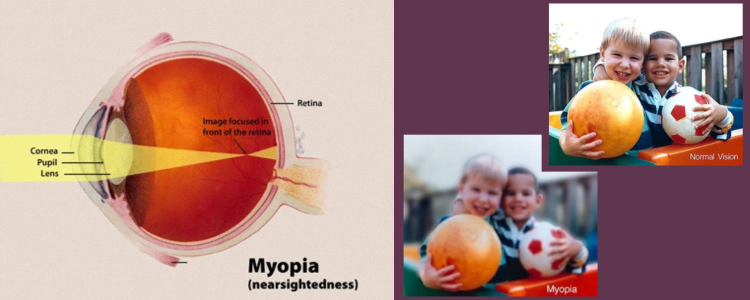

More background on myopia from My Kids Vision.
Myopia Management Options
Not a promise. A possibility.
When I first looked into myopia management on my own I had early heard about the hard nighttime contacts before looking into optometrists who handled myopia management for me. With Zoey's new diagnosis we quickly learned from the optometrist that there wasn't just one approach.
Instead there are apparently different tools all trying to solve the same problem in slightly different ways helping you manage myopia in your growing kids. They all attempt to slow how quickly the eye gets more nearsighted as it grows.
Overnight Hard Contacts
Orthokeratology / Ortho-K
This is what I had originally heard about. They're rigid contacts worn only at night while sleeping and removed in the morning. They work by gently reshaping the surface of the eye overnight so their vision is clearer during the day without glasses or contacts. When worn consistently, they also change how light hits the peripheral retina, which can help slow eye elongation.
Although this was the one I expected I worried it might complicate bedtime routines for us. Also the same set of contacts are worn over many nights (can't remember if it's 30 days or longer) and I worried about it's cleanliness and potential infections while also wondering about time and cost of replacements if broken or lost.
Eye Drops
Low-Dose Atropine
This option was mentioned by our optometrist but wasn't expanded on too much as she didn't recommend them. I appreciated that she shared the option in case I chose to go that route.
That said, looking them up now, they don't replace regular glasses or contacts and are actually used alongside them. These prescription eye drops are used once daily often before bed. The drops don’t correct vision. Instead, they help slow the biological signals that tell the eye to keep growing longer.
Soft Myopia Control Contact Lens
MiSight and many others brands
This is the route we ended up going. The only brand offered at our optometrist was MiSight.
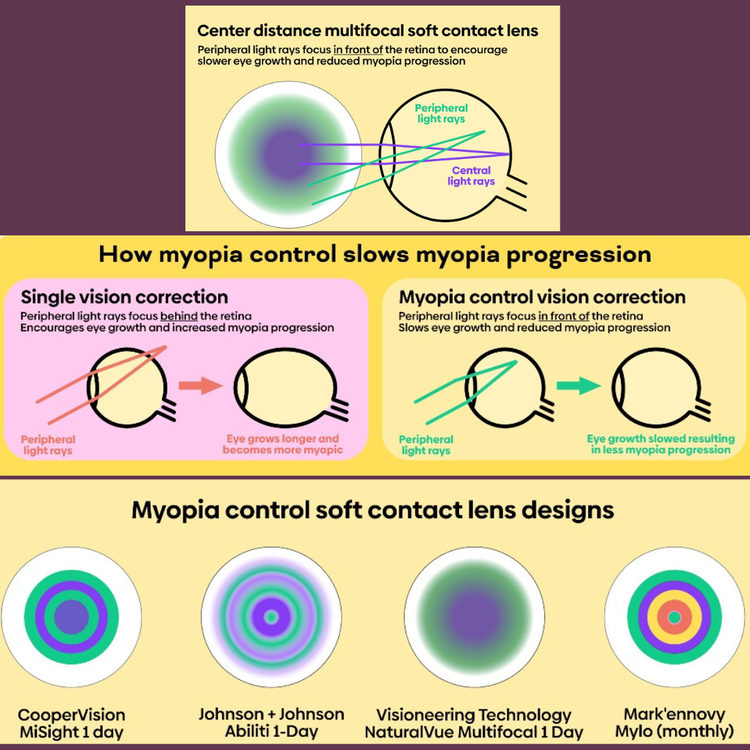
This soft target-style daily disposable contact lense is designed specifically for myopia management while also doing vision correction when worn during the day.
The optometrist explained that these are designed a bit like a target alternating prescription zones with special focusing zones to allow Zoey to see clearly while also slowing her eye elongation. They're highly recommended to be worn, at a minimum of, 6 days a week for 8+ hours a day at a time.
What I loved about this option is that it's a daily disposable which felt simpler and lower-maintenance for us.
Myopia Control Glasses
At the time of our original appointment, summer of 2025, only contact lens were available but our optometrist told us that Canada had approved a glasses version with the same target mechanism. One of her clients with a young daughter had chosen that route and she shared in case we wanted to do the same.
That said, when we returned 6 month later, December 2025, to check Zoey's progress (no prescription change!) we were told that the FDA now approved the glasses. As such, both options may be available to you. When asked Zoey chose to stay with contacts as there was less worry about them falling off her face when playing. Our other daughter, if and when needed, currently thinks the glasses are better.
Our Choice
Looking back, and at the time, I love that there were so many choices but also our optometrist gave us no pressure to choose one now or even choose one at all. That said, with my prescription, I wanted to get ahead of this now.
At the initial appointment Zoey wanted to wear the nighttime hard contacts and, since this was affecting her, I wanted her to be a major part of the decision making process but I also worried about potential infections if the nighttime ones didn't get properly cleaned. When talking with her and Matt at home I realized Zoey was most concerned about people seeing them, hence the night ones, so we looked up videos online, mainly demonstrating how to put them in, and I pointed out how invisible contacts actually are when you're wearing them.
With MiSight lens the winner all around it was time to go back and figure out how to put them in. When returning people seem surprised that Zoey hadn't had glasses yet suggesting that jumping to contact lens may sometimes be a later step in the process. Additionally, the optometrist shared later, when talking about my other daughter at our 6 month checkup, if the prescription is really low there's no point doing glasses, contacts, or even managing the myopia yet as there'd be no reason for her to want to wear them yet.
First Attempt
Not sure if every optometrist office is the same but wanted to share our experience in case it helps you know what to expect when you go in.
Preparing
After Zoey's first appointment and before she tried on her contacts I bought new glasses and, when trying them on, realized the optician (the person who fits glasses and teaches contact lens use) helping me was also booked with Zoey. From her I learned I'd need lint free towels to dry our hands before putting the contacts in. Additionally, she told me to buy some saline drops/contact lens solution, have Zoey wash her hands, drip a drop on her pointer finger, and have her practice touching her eyeball. This way Zoey would be more comfortable putting the lens in when it was time.
Trying Them On
At the first fitting appointment you have to be able to put the contacts in before you can leave with them. We knew that going in. We started with the optometrist who put the lens in Zoey's eyes and chatted with her. We then went over to the optician who was amazing. She talked Zoey through taking them out and then talked her through the steps before coaching Zoey as she put them back in. Zoey got both in and we went home with a weeks worth of contacts and an appointment to return.
Second Appointment
At the time I just moved with the flow, once everything was decided, and it felt weird leaving the first appointment without paying. Looking back I realize that first week was the trial run. We returned a week later where they checked everything was good and seemed fine that I was putting them in for Zoey.
Getting the Contacts
The plan was to mail us a full year of contact lens so we left that second appointment with a couple of small boxes to tide us over until they came. That said it took longer than expected and we ran out, but we were able to drive over and pick up some more samples to tide us over. Going forward we were told if her prescription changed at the six month we'd just trade them in for the new one. That said, I didn't need to test it out as her prescription didn't change and I hadn't even brought them if they did.
Establishing a Routine
Setting Up the Space
Leading up to the appointment, in the kitchen, I separated out my kitchen towels in a more obvious manner for Zoey so it's easier for her to grab a non-linty one in the morning. Over time I moved them to a separate drawer as she still sometimes grabs a fuzzy one, but we haven't had an issue.
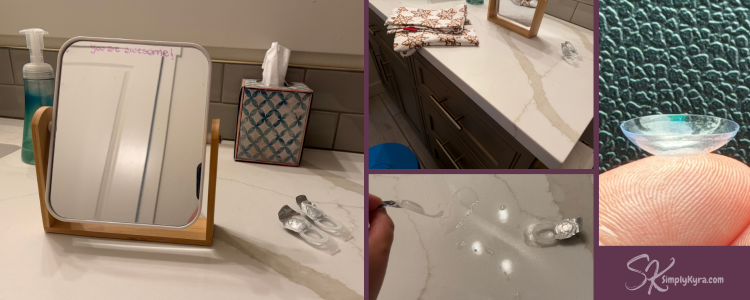
We also designated the main bathroom as the contacts bathroom. There we have a drawer filled with the current set of contact packages and, during the try-on appointment, I ordered a small freestanding mirror so Zoey can have the mirror up close and personal. We also keep a collapsable stool nearby for Zoey to grab along with contact lens solution in case we dumped the solution out too early from the packaging and needed to try again.
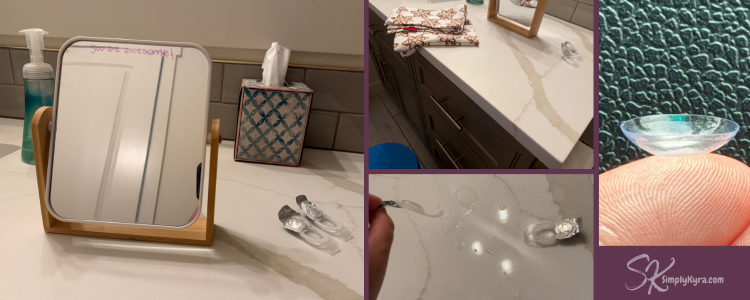
After talking about this with her teacher (she wears contacts too!) and others at her school Zoey started worrying her eyes would be dry. We haven't used them yet but I bought a box of individual drops from Costco and keep them in the bathroom along with a couple in her backpack and desk... after I showed her how to open one. She's never needed them since but figured for the peace of mind and knowing the capsules will stay sealed and thus clean until needed.
The First Mornings
The first morning Zoey quickly got frustrated putting the contacts in so I stepped in and succeeded after a couple of attempts on each eye. For a while, I became the one putting them in as I simply wanted them to be worn every day.
What Helped the Contacts Set Properly (Parent View)
There are tons of tutorials online but I found the best way to do it is to put the contact on the eye and then let Zoey's eye itself do all the work. This means I prep the contact (make sure it's not inside out and in a bowl shape), place on my really dry pointer finger, use my other hand to help hold Zoey's top lid open, balance the palm of my first had (with the contact) against her face to aim, and use my pointer to place the contact on her eye ball. Then I simply get Zoey to look around (mainly down and back and forth). This way her pupil moves under the contact and they connect. Before/while/(it's complicated to explain) letting go of her lid and closing her eyes I try to push the contact up a tad to help it go under the lid and not be pushed out.
This technique led to little ditties being sung when it was time for her to look around based on what was stuck in my head in the moment or what the words Look around led to. Around Christmas I vaguely remember using snow is glistening but can't remember if that was just the tune or also the words.
When Something Felt Off
Sometimes her contacts slip out as we go about the day. Then one day she randomly complained about seeing double... I immediately started worrying what was wrong and debating reach out to the optometrist. Then the contact fell out. After a bunch of back and forth we realized seeing double may mean the contact wasn't in correctly hence why it may have fallen out more easily. To minimize that, as only letters worked, I wrote a message on the mirror so we could add to the process, for a bit, by asking if she saw double and then checking if so.
Learning to Step Back
Over time, when I was tired, I worried what would happen if I was away for a day or longer as I was needed to put her contacts in and Zoey expected my help. That said, when I had Zoey try we both got frustrated and I felt I should step in even though I knew she had to learn.
As such, starting on weekends where we weren't rushed, Matt stepped in to help. He hasn't worn contacts but sits with her, helps her frustration, and helps by holding her eye open so she can put it in. Together they succeeded... while I hovered out of sight but nearby just in case.
One time, while listening, I heard her tell him: Next time I want (the contact) good on my finger and then you hold my eye. I also heard Matt reminding her several times to look at the contact as she puts it in.
After Zoey succeeded with Matt we started having her try on her own more and more before we stepped in to help. Can't remember if it was over Christmas break or one of those weekends but Zoey was able to put them in herself for the first time!
Sure it doesn't happen every day but knowing she is capable (as I knew eventually would happen) feels so liberating. That said I still step in, Matt still helps, and it depends on schedule... but it's working. And she's wearing them almost every day.
Zoey Tips
I wanted to get some tips from Zoey to your little (or big) one:
Getting Them In
First you set it up right on your finger (looks like a bowl on a DRY finger tip), then push it onto your eye. Next you shove it down with your finger and then shove it up with your bottom eyelid. Then blink a lot to make sure it's not sliding. She's gotten pretty good at troubleshooting.
Getting Them Out
Open your eye and pinch the contact out. Another method, Zoey thinks I came up with it but may have been the optician, is to simply rub your eye until it comes out.
Helpful Tracking
Recently I created a post and accompanying printable PDF to help kickstart habits. In it I included Zoey's contacts as an examples.
 Kyra
Kyra
Whether you print it out for you or your kid, I wanted to share it and the idea behind it in case it helps. I’ve also shared the tools that helped us most... feel free to take or leave whatever’s useful.
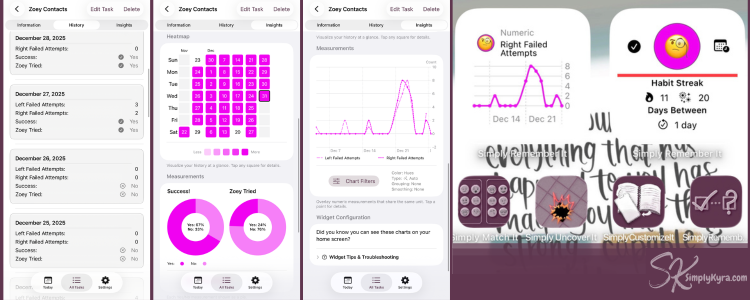
At the time I hadn't set out to use my app Simply Remember It for the contacts but I realized we can track when Zoey wore contacts for a gentle way to make the routine visible since the app had the ability to keep track of streaks (if wanted) and a heatmap (easy way to see when you did or didn't do it). Zoey loved it and it helped me remember too if she forgot. Once we had that down added a check Yes/No to see if Zoey had tried to put the contacts in herself hoping it would give her a gentle push. At the time she didn't want to try and I felt slightly mocked when she chose to add two new counts for how many times I failed before getting the contact into her right and her left eye. Later, once she did succeed, I celebrated with her and added another Yes/No that we called Zoey success!
Where We Are Now
She's doing it! Sure I help when she's tired but when I do she already got one in and I'm just stepping in for the second.
Looking back, I think the general tracking helped more than I expected. She wanted to mark it off each day, and it helped us stay consistent while reminding me we still needed to do it too. We've stopped tracking all the minor metrics (set default values and ignored them rather than deleting) and I later check it off just to keep the streak going in case she asks. And I'm so happy to say the habit has landed and as I write this addition we're at a 46 day daily streak!
Currently, my other daughter is thinking glasses if her eyesight goes more nearsighted over the contacts, but when asked Zoey still wants to wear contacts over glasses and loves that they offer more freedom of movement.
We're still showing up, singing less songs as the habit has landed, and I'm so grateful for options that didn’t exist when I was a kid.
Have you tried one of these solutions? If so did it help? Were there problems? Do you have any tips or tricks with any of the above solutions? Has this helped you?
I'd love for you to share in the comments below!
And like always I hope you’re having a great day.
If you’re interested in getting any of my future blog updates I normally share them to my Facebook page and Instagram account. You’re also more than welcome to join my email list located right under the search bar or underneath this post.
Did this save you time?